


Project Description
ST. PETER’S ABBEY



At a Glance
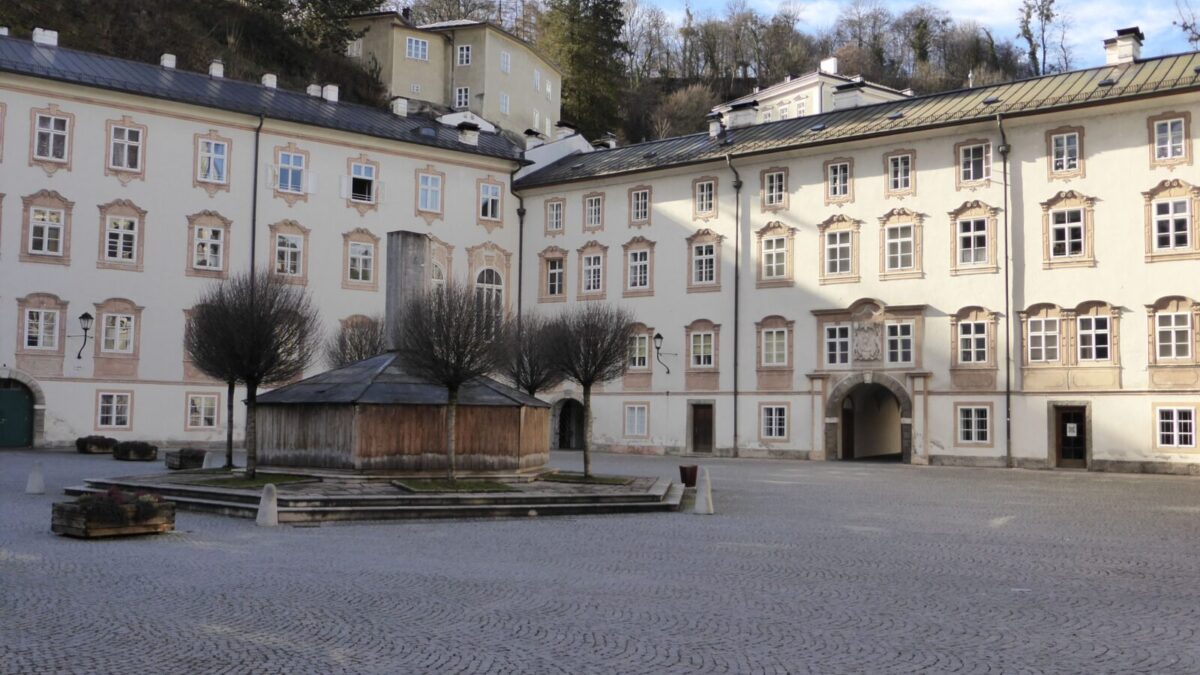
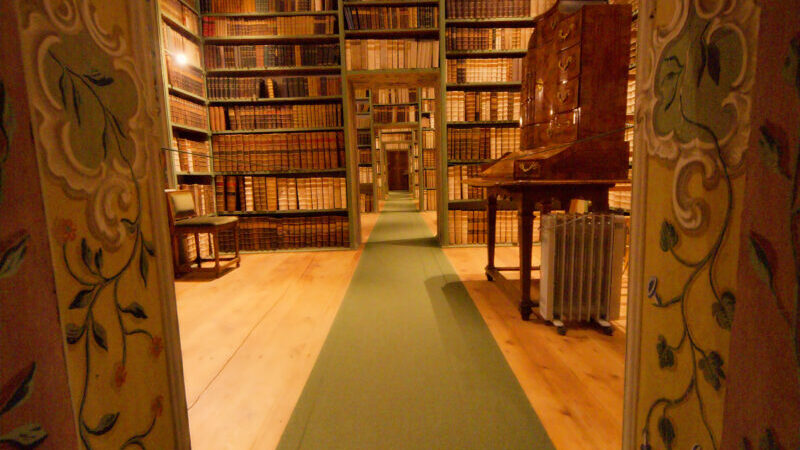
Founded in 696 by Saint Rupert, St. Peter’s Abbey (Archabbey of St. Peter) in Salzburg is considered the oldest continuously operating monastery in the German-speaking world. Situated at the foot of the Mönchsberg, this Benedictine complex has shaped the city’s spiritual, cultural, and economic life for over 1,300 years. The architectural ensemble brings together masterpieces from various eras—ranging from the originally Romanesque abbey church with its opulent Rococo interior and the medieval rock-hewn catacombs to the world-famous St. Peter’s Cemetery. Beyond its architectural significance, St. Peter’s has historically been a center of education and music, and to this day, it combines traditional monastic life with modern commercial enterprises.
Founding and Historical Development
The monastery’s history began around 696, when Bishop Rupert of Worms arrived in Salzburg (ancient *Iuvavum*) to evangelize the region. He established St. Peter’s Abbey as both a missionary monastery and an episcopal seat. Until 987, the offices of the Archbishop of Salzburg and the Abbot of St. Peter were held by the same person. Over the course of the Middle Ages, the abbey developed into an outstanding center of monasticism and intellectual life:
- Medieval scriptorium: The monks produced significant manuscripts, including the Book of Confraternity (Verbrüderungsbuch) of 784.
- University of Salzburg: In 1622, Archbishop Paris Lodron founded the Benedictine University with the close involvement of the abbey, ensuring St. Peter’s remained an academic hub for centuries.
- Archabbey: In 1927, the abbey was elevated to the rank of archabbey in recognition of its special historical status.
St. Peter’s Abbey Church
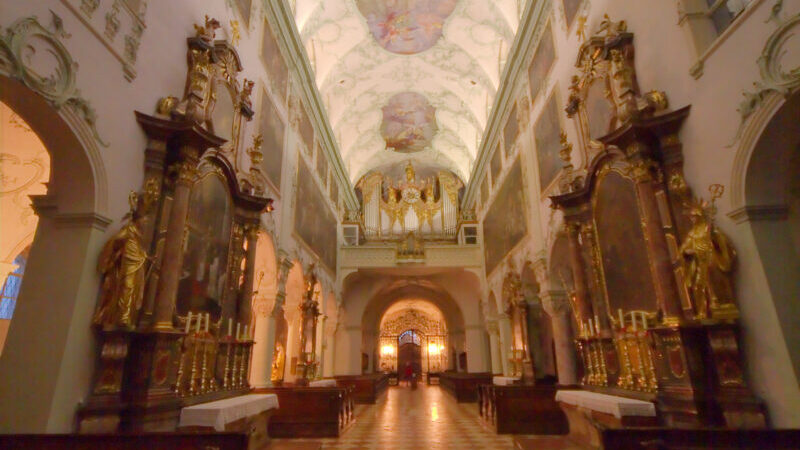
The abbey church forms the architectural heart of the monastery. The core of the current structure dates back to a three-aisled Romanesque basilica from the 12th century (1131–1143), while the massive church tower is even older at its core.
Over the centuries, the church underwent several transformations:
- Facades and vestibule: A Gothic vestibule and the Romanesque portal have been preserved.
- Rococo redesign: Under Abbot Beda Seeauer, the interior was given a magnificent new look starting in the mid-18th century, featuring white-and-green stucco, ceiling frescoes, and opulent altars.
St. Peter’s Cemetery and the Catacombs
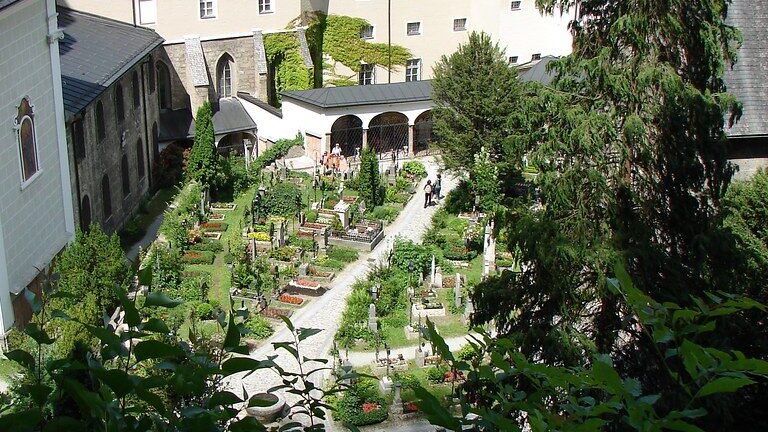
Nestled against the rock face of the Mönchsberg, St. Peter’s Cemetery is one of the oldest and most atmospheric burial grounds in Europe. Established as early as Late Antiquity, it features artistically significant arcade tombs and family vaults.
- Notable Graves: Among those laid to rest here are Nannerl Mozart (Wolfgang Amadeus Mozart’s sister) and the composer Michael Haydn.
- Catacombs: Hewn directly into the rock of the Mönchsberg, these early Christian chambers—which include the St. Gertrude Chapel (dating from 1178)—served not as burial sites, but as early places of assembly and worship.
- Pop Culture: The cemetery and rock chambers gained international fame as the setting for the escape scene in the Hollywood film The Sound of Music.
Significance for Music History
The abbey maintains a long tradition of supporting music. Leopold and Wolfgang Amadeus Mozart, as well as Johann Michael Haydn, all had close ties to the monks. In 1769, at the age of 13, Mozart composed the famous Dominicus Mass for the abbot of the time. Furthermore, it is believed that the premiere of Mozart’s Great Mass in C Minor took place in the abbey church in 1783, featuring his wife Constanze as the soprano soloist.
Commercial Enterprises and the Abbey Today
True to the Benedictine motto *“Ora et labora”* (pray and work), St. Peter’s continues to combine spiritual life with traditional trades to this day:
- Stiftskulinarium St. Peter: This restaurant is considered the oldest documented eatery in Central Europe (first mentioned in 803 by Alcuin of York).
- Abbey Bakery: Renowned for its traditional wood-fired bread made from natural dough.
- St. Peter’s Museum: As part of the Salzburg DomQuartier, the monastery museum showcases valuable art treasures from the Archabbey’s collections (such as the 12th-century St. Henry’s Chalice).
+43 662 844576
The opening times in the complex of the Archabbey / Monastery of St. Peter Salzburg differ depending on the area:
Collegiate Church of St. Peter
| Monday | Tuesday | Wednesday | Thursday | Friday | Saturday | Sunday |
|---|---|---|---|---|---|---|
| 8 am – 8 pm | 8 am – 8 pm | 8 am – 8 pm | 8 am – 8 pm | 8 am – 8 pm | 8 am – 8 pm | 8 am – 8 pm |
Petersfriedhof Summer (Apr. – Sep.)
| Monday | Tuesday | Wednesday | Thursday | Friday | Saturday | Sunday |
|---|---|---|---|---|---|---|
| 6.30 am – 8 pm | 6.30 am – 8 pm | 6.30 am – 8 pm | 6.30 am – 8 pm | 6.30 am – 8 pm | 6.30 am – 8 pm | 6.30 am – 8 pm |
Petersfriedhof Winter (October – March)
| Monday | Tuesday | Wednesday | Thursday | Friday | Saturday | Sunday |
|---|---|---|---|---|---|---|
| 6.30 am – 6 pm | 6.30 am – 6 pm | 6.30 am – 6 pm | 6.30 am – 6 pm | 6.30 am – 6 pm | 6.30 am – 6 pm | 6.30 am – 6 pm |
Catacombs in the rock summer (May – September)
| Monday | Tuesday | Wednesday | Thursday | Friday | Saturday | Sunday |
|---|---|---|---|---|---|---|
| 10 am – 12.30 pm and 1 pm – 6 pm | 10 am – 12.30 pm and 1 pm – 6 pm | 10 am – 12.30 pm and 1 pm – 6 pm | 10 am – 12.30 pm and 1 pm – 6 pm | 10 am – 12.30 pm and 1 pm – 6 pm | 10 am – 12.30 pm and 1 pm – 6 pm | 10 am – 12.30 pm and 1 pm – 6 pm |
Catacombs in the rock winter (October – April)
| Monday | Tuesday | Wednesday | Thursday | Friday | Saturday | Sunday |
|---|---|---|---|---|---|---|
| 10 am – 12.30 pm and 1 pm – 5 pm | 10 am – 12.30 pm and 1 pm – 5 pm | 10 am – 12.30 pm and 1 pm – 5 pm | 10 am – 12.30 pm and 1 pm – 5 pm | 10 am – 12.30 pm and 1 pm – 5 pm | 10 am – 12.30 pm and 1 pm – 5 pm | 10 am – 12.30 pm and 1 pm – 5 pm |
Museum St. Peter (in the DomQuartier)
| Monday | Tuesday | Wednesday | Thursday | Friday | Saturday | Sunday |
|---|---|---|---|---|---|---|
| 10 am – 5 pm | closed | 10 am – 5 pm | 10 am – 5 pm | 10 am – 5 pm | 10 am – 5 pm | 10 am – 5 pm |
Access to the various areas of St. Peter’s Abbey is regulated as follows:
1. Free areas
- St. Peter’s Abbey Church: Admission to the Baroque church is free.
- St. Peter’s Cemetery: The historic cemetery is also open to visitors free of charge.
2. Areas requiring an admission fee
- Rock Catacombs:
- Adults: €2.00
- Children & Youths (6–18 years): €1.50
- Groups (10+ people) / Seniors: €1.50 per person
- School classes: €1.00 per person
- With the Salzburg Card: One-time free admission.
- St. Peter’s Museum (within the DomQuartier):
- The monastery museum is part of the combined ticket for the Salzburg DomQuartier.
- Adults: approx. €13.00 (DomQuartier day ticket)
- Reduced / Youths: approx. €10.00 or €5.00
- With the Salzburg Card: One-time free admission.




By Car
Since direct vehicle access to the St. Peter district is restricted to those with a special permit, it is best to use one of the nearby parking garages:
- Mönchsberg Garage / Altstadt Garage (Recommended):
- Access: Via the Hildmannplatz entrance.
- Walking time: The Toscaninihof exit brings you out right next to St. Peter’s Abbey (approx. 2-minute walk).
- Special feature: If you visit shops or restaurants in the Old Town (including the Stiftskulinarium), you can have your parking ticket validated for a discounted rate under the “Altstadt-Parken” (Old Town Parking) scheme.
- Barmherzige Brüder / Raiffeisen Parking Garage:
- Located south of the Old Town. From there, it is a walk of approx. 7–10 minutes via Kaigasse to the Abbey.
By Public Transport
The nearest stops are just a few minutes’ walk from the Abbey:
- From Salzburg Central Station (Hauptbahnhof):
- Take trolleybus lines 1, 3, 5, or 6.
- Alight at: Rathaus or Ferdinand-Hanusch-Platz stop.
- Walking time: From the stop, it takes about 3 to 5 minutes to walk via Universitätsplatz or Kapitelplatz directly into the St. Peter district.
- Entrance via the Mönchsberg Lift:
- Alternatively, you can take bus lines 1 or 4 to the Herbert-von-Karajan-Platz stop. From there, the path leads directly to the abbey via the Festungsberg Tunnel/Tuchmacher Passage.

