


Project Description
COURT CHURCH INNSBRUCK


Key Facts at a Glance
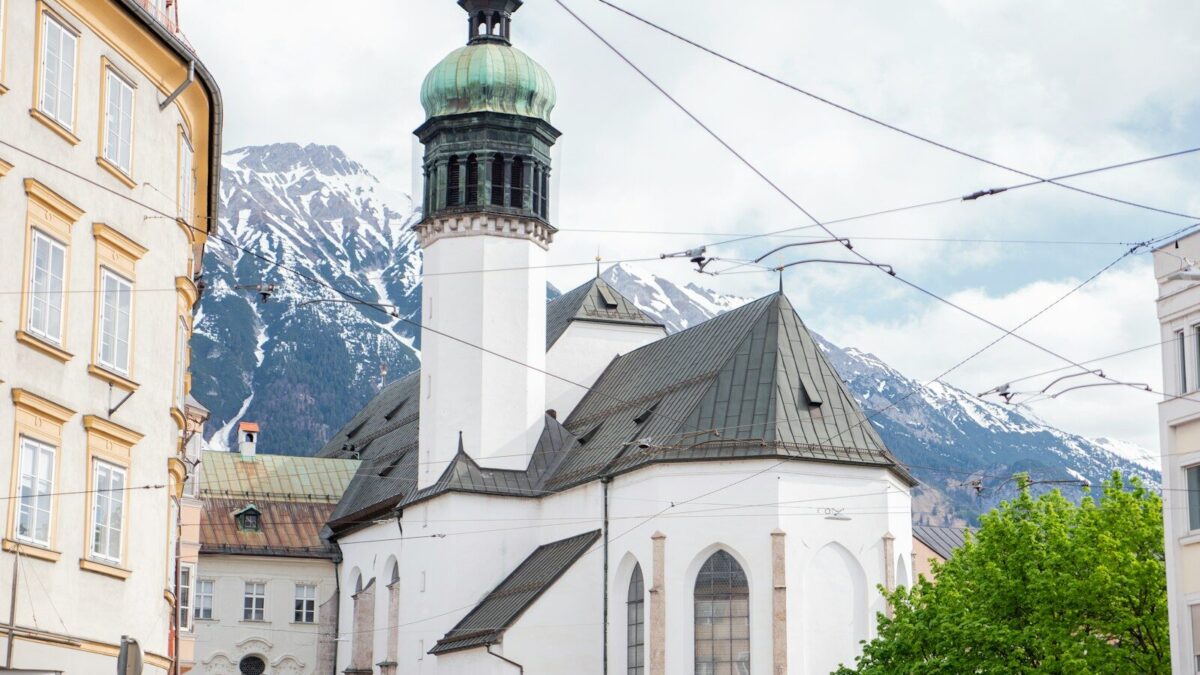
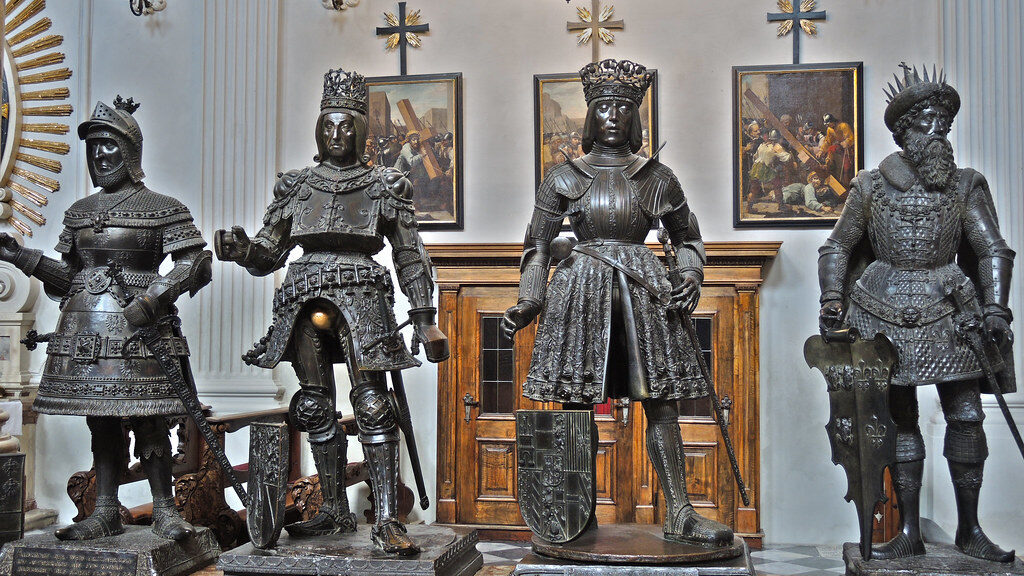
The Court Church (Hofkirche) in Innsbruck—popularly known as the “Church of the Black Men” (*Schwarzmander-Kirche*) due to its monumental bronze figures—is considered one of the most significant Renaissance monuments in Europe. It was built between 1553 and 1563 under Emperor Ferdinand I as a magnificent memorial church for his grandfather, Emperor Maximilian I (1459–1519). Although Maximilian himself was laid to rest in Wiener Neustadt, his empty, elaborate cenotaph—situated in the center of the nave and surrounded by 28 larger-than-life bronze statues of historical and legendary rulers—forms the heart of the edifice. Furthermore, the church houses the Silver Chapel (*Silberne Kapelle*) as well as the tombs of prominent Tyrolean figures, such as Andreas Hofer.
Historical Background: An Imperial Tomb Without an Emperor
The origins of the Court Church are closely linked to Emperor Maximilian I’s profound preoccupation with his own legacy. During his lifetime, the Habsburg ruler planned a colossal tomb intended to secure his renown and the lineage of his dynasty for centuries to come. Originally, this was intended for the St. George’s Chapel at the castle in Wiener Neustadt—where Maximilian was indeed interred following his death in 1519.
However, because the monumental program of figures was simply too heavy and too large for the small castle chapel in Wiener Neustadt, the bronze statues—which had already been cast—remained in Innsbruck, one of the most important European centers for ore and bronze casting at the time. Maximilian’s grandson, Emperor Ferdinand I, ultimately decided to commission a dedicated church in Innsbruck to provide a fitting setting for his grandfather’s unfinished life’s work. Construction, based on plans by Andrea Crivelli, began in 1553 and was completed in 1563 under the supervision of the court architect Nikolaus Türing the Younger.
The Tomb of Maximilian I and the “Black Men” (“Schwarze Mander”)
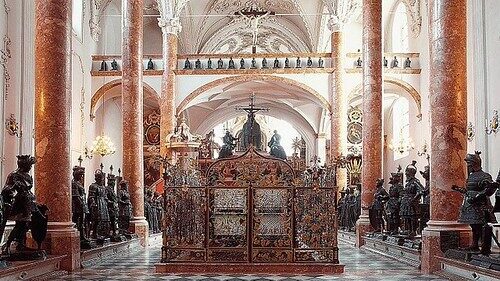
The center of this three-aisled hall structure is dominated by the imposing cenotaph (an empty tomb) of Maximilian I:
- The Sarcophagus: Resting on a high marble pedestal is a bronze statue of the Emperor in his coronation regalia, accompanied by the four cardinal virtues (Justice, Prudence, Fortitude, and Temperance). The sides of the sarcophagus are adorned with 24 finely crafted reliefs made of white Carrara marble—created primarily by Alexander Colin—which depict key political and military milestones from Maximilian’s life.
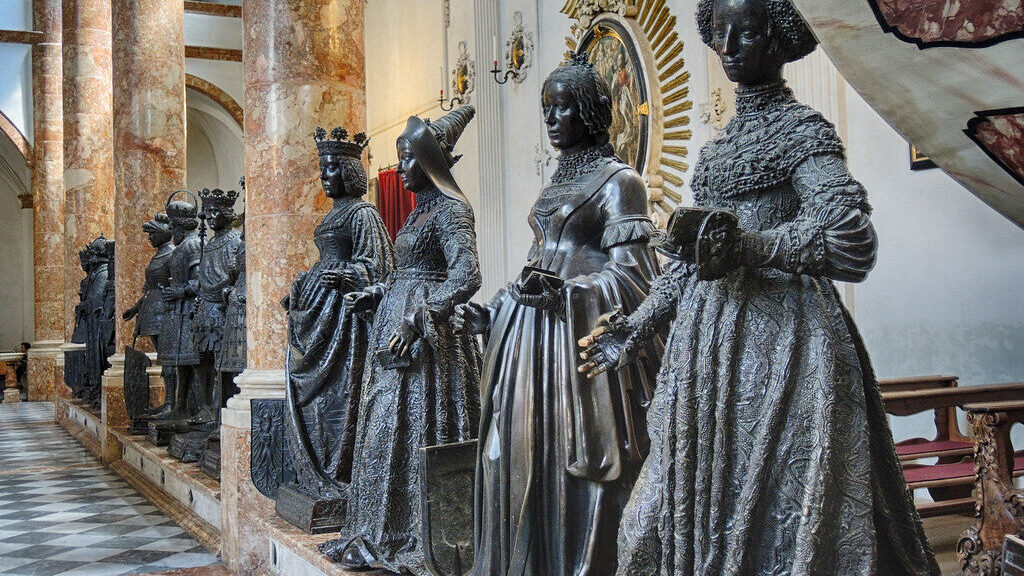
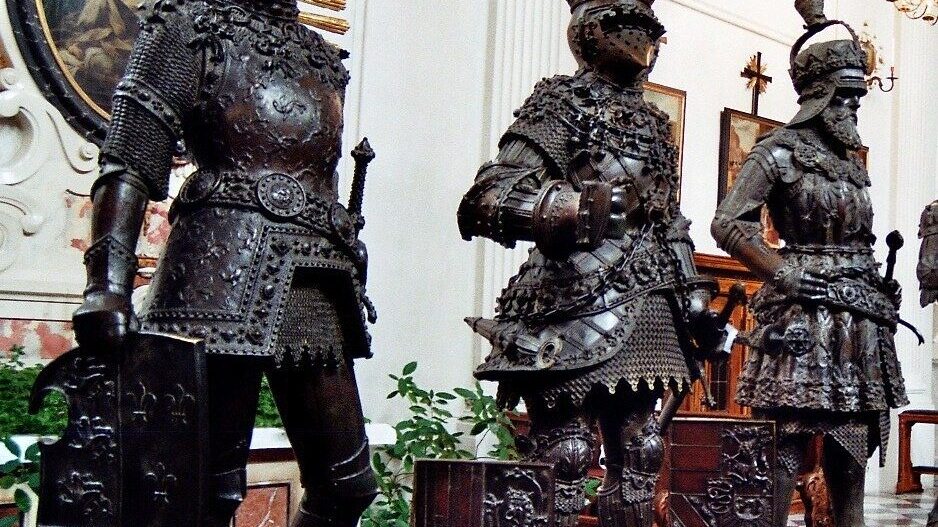
- The 28 Bronze Figures (“Schwarze Mander”): Surrounding the tomb, like an eternal honor guard, stand 28 larger-than-life bronze statues (20 men and 8 women, each approximately 2 to 2.5 meters tall). They represent actual ancestors and relatives of Maximilian—such as Duke Charles the Bold of Burgundy, Emperor Frederick III, and King Philip the Handsome—as well as mythical and historical archetypes of Christian chivalry, including King Arthur and Theodoric the Great. The figures were designed by artists such as Albrecht Dürer, Jörg Kölderer, and Gilg Sesselschreiber.
Other Sights Within the Church
In addition to the imperial tomb, the Court Church (Hofkirche) contains other areas of outstanding significance in terms of art and regional history:
- The Silver Chapel: Accessible via a staircase from the side aisle, this two-story funerary chapel was commissioned by Archduke Ferdinand II for himself and his wife, Philippine Welser—a marriage considered unequal in status at the time. The chapel owes its name to its precious silver altar dedicated to the Virgin Mary. It also houses one of the oldest playable organs in Austria (the so-called Ebert Organ, dating from 1561).
- Tomb of Andreas Hofer: In the left side aisle, a Neoclassical marble monument commemorates the Tyrolean freedom fighter Andreas Hofer, whose remains were brought from Mantua to Innsbruck in 1823 and interred here. Nearby lie other figures who fought in the Tyrolean Uprising of 1809, such as Speckbacher and Haspinger.
- Architecture & Organ: While the exterior is intentionally simple, the interior captivates the viewer through the contrast between bright, late-Gothic net-vaulted ceilings, red marble columns, a magnificent Renaissance portal, and the dark splendor of the bronze figures.
+43 512 594 89 – 510
| Monday | Tuesday | Wednesday | Thursday | Friday | Saturday | Sunday |
|---|---|---|---|---|---|---|
| 9 am – 5 pm | 9 am – 5 pm | 9 am – 5 pm | 9 am – 5 pm | 9 am – 5 pm | 9 am – 5 pm | 12:30 pm – 5 pm |
Single Tickets & Combination Tickets
| Ticket Type | Regular (Adults) | Reduced* |
|---|---|---|
| Single Ticket: Court Church (Hofkirche) | €9.00 | €7.00 |
| Combination Ticket (Court Church + Tyrolean Folk Art Museum) | €14.00 | €11.00 |
| “5-for-1” Combination Ticket (all five sites of the Tyrolean State Museums) | €18.00 | €14.00 |
*Reduced rates generally apply to seniors, students up to the age of 27, apprentices, individuals performing compulsory military or civilian service, and persons with disabilities (upon presentation of valid identification). Valid for the Ferdinandeum, the Tyrolean Folk Art Museum, the Court Church (Hofkirche), the Armoury (Zeughaus), and the TIROL PANORAMA with the Kaiserjäger Museum (valid for one year).
Free Admission & Discounts
- Children &
- Young people: Admission is free for everyone under the age of 19.
- Combination with the Hofburg Innsbruck: Upon presentation of a ticket for the Hofburg Innsbruck, you generally receive a 50% discount on admission to the Tyrolean State Museums (and vice versa).
- Innsbruck Card: Admission to the Court Church (Hofkirche) is already included in the Innsbruck Card (24, 48, or 72 hours).
- Free admission days / Special arrangements: Admission is free on the Austrian National Day (October 26) and occasionally on specific promotional days organized by the State Museums.




The Hofkirche (Court Church) in Innsbruck is centrally located at Universitätsstraße 2 in the heart of the city—right next to the Hofburg (Imperial Palace) and close to the Old Town—and is easily accessible by both car and public transport.
By Public Transport:
- From the train station: From Innsbruck’s main railway station (Hauptbahnhof), you can reach the Hofkirche on foot in about 20 minutes by walking through the city center, or travel comfortably using the Innsbruck public transport (IVB) network, heading toward the city center, Congress, Rennweg, or Universitätsstraße.
- On foot within the city center: As the church is situated at the junction of the Old Town, the Hofburg, and the university district, it is perfectly positioned to be included in a walking tour of the city.
By Car:
- Via the motorways: Take the Inntal Motorway (A12) or the Brenner Motorway (A13) toward Innsbruck, then follow the signs for the city center (Zentrum), Old Town (Altstadt), Congress, or Rennweg/Universitätsstraße.
- Parking nearby: There is virtually no parking available directly in front of the church. A convenient alternative is a nearby underground car park, such as the Innsbruck Altstadtgarage at Innrain 4 (open 24/7), from which the Hofkirche is just a short walk away.
- Short-term parking zones: Innsbruck’s city center features paid short-term parking zones; therefore, using a parking garage is generally the better choice for a stress-free visit.

